Which Claude model is best for resume writing? For most people, Claude Opus 5.5, which comes with the $20 Pro plan. Claude Sonnet on the free plan is good enough to draft and tailor a resume if you apply to a few jobs a week. Claude Fable 5.1, the most capable model Anthropic offers, is overkill for this job: it is not part of Pro's included usage, it is slower, and it uses your limits faster without making the document any more true.
The reason the top model is not the right answer is that resume writing is not hard reasoning. It is a short, rule bound job against one document: pick what fits, reorder it, rewrite it tightly, and do not invent anything. Every model in the current lineup can do the writing. What goes wrong goes wrong at the gaps, where the job asks for something your resume does not have, and a bigger model does not fix that. What it is allowed to write from, and whether a separate pass checks what it wrote, does.
This guide is published by JobShifu, which sells a resume tailoring product and runs it on Anthropic's Claude. Plan prices and model access below were read off Anthropic's own pages on 27 October 2026. Every other number comes from JobShifu's own published posts or measurements, labelled as such and dated.
The short answer: which model, which plan
| If you | Use | On | Why |
|---|---|---|---|
| Apply to a few jobs a week | Claude Sonnet | Free ($0) | Good enough to tailor and check one resume; the limit is how much you can run per session, not quality |
| Tailor for most of your applications | Claude Opus 5.5 | Pro ($20 a month, or $17 a month billed yearly) | Stronger on the checking half, and at least 5x the free plan's usage per session, enough to run every check |
| Also use Claude heavily for other work | Opus 5.5, Fable 5.1 sparingly | Max (from $100 a month) | Only plan where Fable is included, capped at half your weekly limit |
| Want the "best" model for its own sake | Not Fable | Any plan | It runs on paid usage credits on Pro and buys you nothing a resume needs |
Plan details from Anthropic's pricing page [8] and its help article on Fable [9].
The current Claude models, and what each is good for here
As of October 2026 Anthropic's lineup runs, from most to least capable, Claude Fable 5.1, Claude Opus 5.5, Claude Sonnet 5.5 and Claude Haiku 5.5 [10].
- Claude Fable 5.1. Anthropic describes it as for demanding reasoning and long-horizon agentic work, lists it as the slowest of the four, and prices it highest [10]. It is not on the free plan, it runs on pay as you go usage credits on Pro, and on Max it is capped at half your weekly limit, which it uses faster than other models [9]. A resume is neither long-horizon nor agentic. If what you want is an agent that applies for you, that is a different question, answered in which AI agents can apply for jobs, and where each one stops.
- Claude Opus 5.5. The current Opus, and Anthropic's suggested starting model for most work [10]. Use it for the tailoring prompt and the eight checks below. This is the one worth paying for.
- Claude Sonnet (Sonnet 5.5 at the time of writing; Anthropic does not publish which version each plan serves, so check the model menu in the app). Anthropic's own guide calls Sonnet the daily driver and the model to start with for writing [11]. It is what the free plan gives you, and it handles reading a posting, the gap analysis and a first draft well. On the checks, read its verdicts closely: they are the steps where the model has to notice something that is missing.
- Claude Haiku (Haiku 5.5 at the time of writing). Fast and light. Fine for a quick pass that flags phrasing that reads as generated; not for deciding whether a line is true.
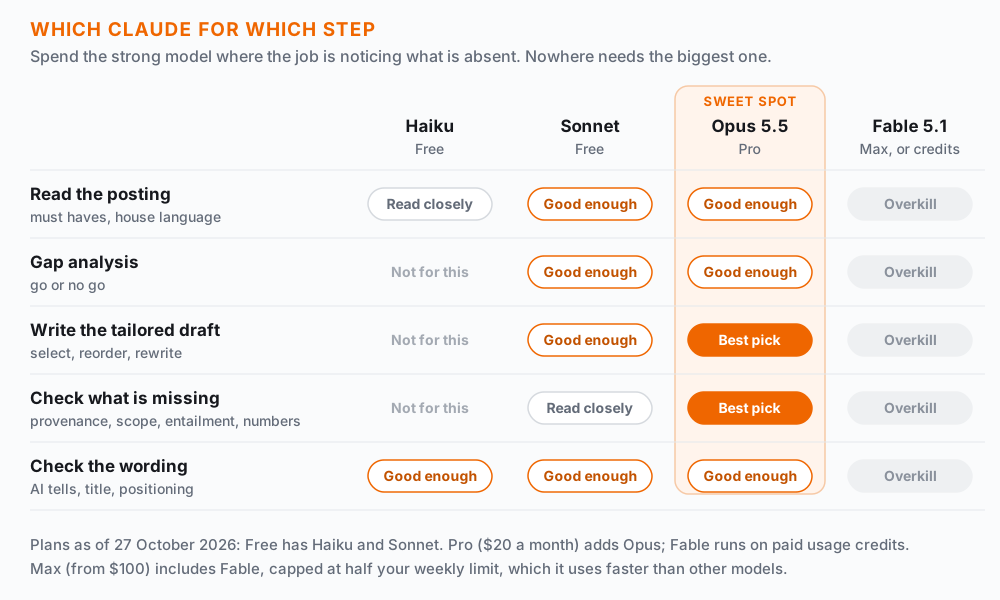
Anthropic's guide makes the same point this page does, from the other side: picking a heavier model than the task needs costs you usage for no gain [11].
Why the most capable model is not the better choice for a resume
Three reasons, in order of how much they matter.
The failure is not about writing quality. A model asked to make a document match a posting, holding nothing of yours that answers that posting, does not stop and report the absence. It continues, from the only material it has, which is the posting. JobShifu's benchmark ran one control resume through four tailoring products on 27 August 2026. The resume contained Kafka twice, Spark five times and Iceberg three times, and never mentioned Apache Flink. A bullet generator asked for Flink produced three bullets asserting Flink experience, one with an unfilled placeholder, "over X million events daily". Saving one moved the match score from 9 percent to 15 percent, and Flink became the only keyword the screen marked as present, while Kafka, Spark and Iceberg, all genuinely in the document, stayed marked missing [3]. A smarter model writes that bullet more convincingly. It does not stop writing it.
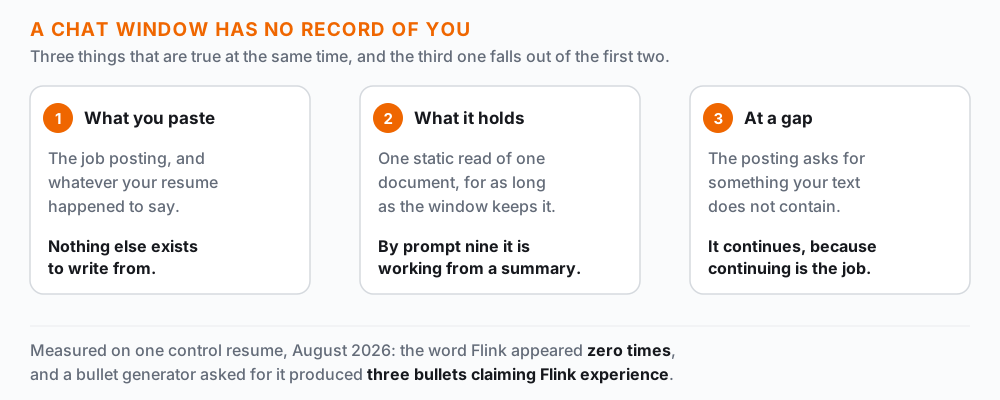
The limit you hit is usage, not intelligence. A careful run of this loop is about fourteen prompts per application, with your full master resume in every one [2]. What stops people finishing it is running out of messages before the checking half, and the heavier the model, the sooner that happens. Opus 5.5 on Pro is the point where you can run every check on every application without rationing.
Newer and bigger has not automatically been better, even for us. JobShifu tests every model change on the real task before it ships, and three of those tests kept the older or smaller model:
- Opus 5 against Opus 4.8, tailoring, July 2026. Opus 5 scored better on quality in a small two-case trial, and took about 59 percent longer and cost about 18 percent more. Two cases were not enough to move a step every user waits on.
- Sonnet 5.5 against Sonnet 4.6, the entailment check, 28 September 2026. The check that asks whether a line's cited source actually supports it, over 15 test resumes: 166 fine lines and 42 planted fabrications. Sonnet 4.6 flagged none of the good lines and caught all 42. Sonnet 5.5 flagged 2 good lines and caught 38, and all four misses were inflated numbers. It also cost about 25 percent more per run despite a lower list price, because it used more tokens to say the same thing.
- Haiku 5.5 against Sonnet 4.6, five matching and grading steps, 14 to 16 October 2026. On every one, Haiku 5.5 agreed with the larger model less often than two runs of the larger model agreed with each other. On the gap analysis it hedged toward "partial match" both ways, including on skills the resume did not have.
The lesson for your own chat window: a version number is not evidence. If you switch models mid search, rerun the checks on one application you already know well and compare.
What JobShifu runs, and why it is still on Opus 4.8
As of 27 October 2026, JobShifu's tailoring pass runs on Claude Opus 4.8, Claude Sonnet 4.6 reads postings and runs the scope and entailment checks, and Claude Haiku 5.5 runs short mechanical passes such as flagging generated phrasing [5].
That is not a claim that 4.8 is better than Opus 5.5. It has not been measured against it yet, and Opus 5.5 is cheaper per token. The reason it has not simply been swapped in is specific. JobShifu runs tailoring with the model's extended thinking switched off, and Opus 5.5 cannot switch it off. In the July test, the Opus 5 setup with thinking on covered fewer of the job's requirements than the same model with thinking off, 14 of 20 against 17 of 20. So moving to Opus 5.5 is not a drop-in change; it changes how the model works on the one step every user waits for, and it moves when a test on real resumes says it should.
None of that is your problem in a chat window. There, Opus 5.5 is the right pick.
Is Claude a good idea for tailoring a resume to every job?
Per job, yes, and the loop is not a secret. JobShifu publishes it in full: nine steps and fourteen prompts, from building a master document you never send, through decoding the posting, a gap analysis and a go or no go decision, to the rewrite itself [2]. Six of the fourteen prompts produce a draft. The other eight check it.
Two things break, and neither is about which model you picked.
The first is memory. Your master document has to be in context for every prompt. Lean on the conversation instead of pasting it again and by prompt nine the model is working from a summary of a summary. In a long session it also starts carrying the last job's language into this one, and the drift is invisible because the output stays fluent [2]. A Claude Project, below, fixes this.
The second is the gap, above. The fix is a rule plus a check: the prompt forbids writing past your evidence, and a separate pass checks what was written.
Is ChatGPT or Claude better for a resume?
Use the one you already pay for. JobShifu has not published a head to head between the two, so this page does not name a winner. In a bare chat window either one is handed two instructions that quietly conflict, match this job and stay true to this person, with no way to know which matters more when both cannot be satisfied [4].
What decides the result in either is the tailoring prompt's hard rules: use only what is in your master resume, list anything that would help but is not there under a separate heading instead of writing it, do not add or round a number, do not upgrade a verb, and keep every bullet under the employer it happened at [2]. Those rules turn a gap into a reported gap instead of a written one, with either model.
How do I set up a Claude Project for job hunting?
Make one Project for the search, put your master resume and the rules in it, and start a new chat inside it for every job. Projects are on the free plan too, up to five of them [8], and each holds its own files and instructions [6].
- Create a Project called something like "Job search 2026".
- Add your master resume to the Project's knowledge. The long one with every number, tool and small project in it, not the one page version you send. Every chat inside the Project can read it, which is the fix for the memory problem [6].
- Paste the hard rules into the Project instructions. Use only content from the master resume. List anything that would improve the fit but is not in it under "NOT WRITTEN, NOT IN YOUR EVIDENCE". Do not add, change or round a number. Do not upgrade a verb. Keep every bullet under the employer it happened at. The wording is in Prompt 6 of the prompts guide, ready to copy [2].
- Pick the model in the chat's model menu. Opus 5.5 if you are on Pro, Sonnet on the free plan. Leave Fable off unless you are on Max and have limit to spare.
- One chat per job. Before you spend one on a posting, check it is likely still active. Then paste the posting, run the tailoring prompt, and ask for a change log that quotes the master line behind every changed line.
- Run each check as its own message in the same chat: provenance first, then scope, entailment, numbers, role integrity, generated phrasing, title seniority and positioning. One check per message is slower, and it finds more than the first problem [2].
- Write back. When a posting reminds you of real work your master resume leaves out, add it to the knowledge file, not just to this application, so the next job starts from more.
Is Claude good at reviewing resumes?
Yes, if each kind of review is its own prompt. A tailored draft fails in eight distinct ways, with different causes and different fixes [2]:
- Provenance. A line with no basis anywhere in your master document.
- Scope. Real work described at a size it was not.
- Entailment. A tool or outcome in the line and in none of your evidence.
- Jagged metrics. A number that exists nowhere in your source, or a timeframe contradicting your dates.
- Role integrity. A true bullet filed under the wrong employer.
- AI tells. Language that reads as generated rather than as yours.
- Title seniority. A headline a level above what your evidence supports.
- Positioning. The right evidence, sitting below the part anyone reads.
Ask one prompt to find all eight and it finds the most obvious failure, usually the buzzwords, announces the resume is now strong, and stops [2]. This is where the stronger model earns its place: checks 1 to 4 ask the model to notice what is absent, which is harder than writing what is present. If you only upgrade one step to Opus, make it this one.
The same loop, with a Vault behind the model
Powered by Anthropic's Claude, JobShifu's resume tailoring runs those same nine steps with two things a chat window does not have.
The first is the material. Career facts live in a Vault, added one at a time and confirmed with a source and a date, and the product states the contract on its first screen: "The Vault holds everything true about you. Tailoring picks what matches this job, and nothing lands on a resume that is not in here." Every proposed change names the confirmed units it draws from, and proposals citing anything unconfirmed are dropped before they reach you [4].
The second is where the check sits. Run through prompts, the eight checks are advice: the model reports that a line has no source, and you decide. In JobShifu eleven checks run on every build and two block. Provenance is ordinary code reading the citations on each line, and a line citing nothing fails the build. Job-posting echo is ordinary code too, and it fails a line carrying a term from the posting that appears nowhere in your Vault or uploaded resume. Two of the nine that only report are model backed and fail open, which is why the page describing them declines to call them guarantees [4].
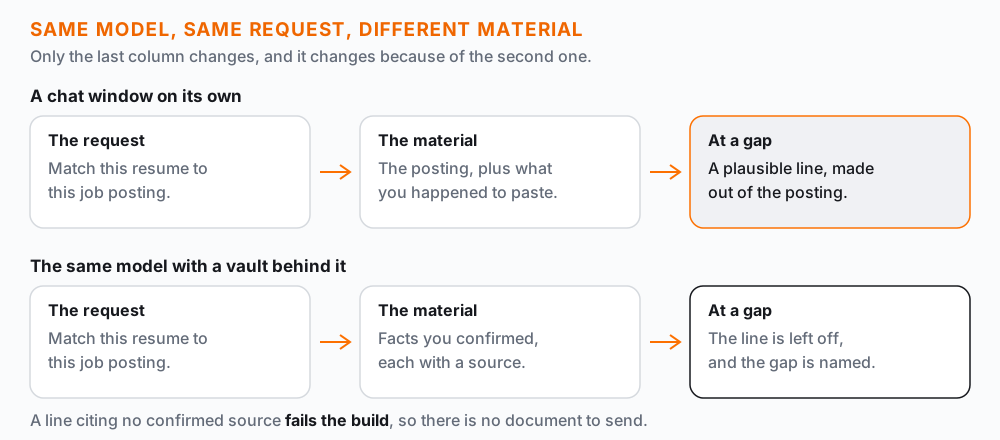
What that looked like on a real run, from the same benchmark: keyword coverage moved from 6 out of 15 to 10 out of 15, entirely from facts already confirmed in the Vault, Fit came out at 80 percent, and Readiness moved from 51 to 76. One baseline line did not make it onto the tailored document, with a notice saying why: "1 baseline line(s) had no confirmed evidence behind them and were left off. Confirm the fact in your Vault to bring them back." [3]
The cost sits in the same sentence. The Vault has to be filled in before the tailoring is any good, and a notice about a dropped line is a chore no chat window will ever hand you [3].
On price, for comparison with a Claude plan: JobShifu's Pro is $239.99 a year, about $20 a month; there is also $74.99 every 3 months, or $29.99 month to month [7]. The free tier needs no card and includes two fully tailored resumes every day [7]. You do not need a Claude subscription to use it.
Common questions
Is Claude Pro worth it for resume writing?
If you are tailoring for most of your applications, yes: it adds Opus 5.5 and at least five times the free plan's usage per session [8], which is what lets you run every check instead of stopping after the draft. If you apply to a handful of jobs a month, the free plan's Sonnet is enough. Max is not worth it for a job search alone.
Is Claude Fable worth it for a resume?
No. It is built for long, multi step reasoning and agentic work [10], it costs extra usage credits on Pro and uses Max limits faster [9], and the thing that goes wrong on a resume, writing past your evidence at a gap, is not something a more capable model stops doing.
Can Claude write a resume from scratch?
It can produce a document that looks like one, and every specific in it will have come from the posting or from the general shape of a resume, because nothing of yours was in front of it. The useful version is the other way round: build a master document first, then ask the model to select and reorder rather than write [2].
Do I have to paste my whole resume into every prompt?
In a plain chat, effectively yes; skip it and by the ninth prompt the model is answering from a summary of a summary [2]. A Claude Project removes the pasting: the master resume sits in the Project's knowledge and every chat inside it can read it [6]. Start a fresh chat for each job either way.
Is tailoring per job worth the time on a weak fit?
Often not, and the loop has a step for deciding before the expensive part. Steps 3 to 6 are cheap and tell you whether the rewrite is worth doing at all, so on a weak fit, run the gap analysis, write anything new back into your master document, and stop [2].
Sources
- r/ResumeCoverLetterTips, "Is using Claude to tailor a new resume for every different job a good idea?": reddit.com/r/ResumeCoverLetterTips/comments/1uwz0n5. Seen in Google results for "claude ai resume", 4 September 2026.
- JobShifu, "ChatGPT prompts to tailor a resume to a job description, free": /blog/tailor-resume-to-job-description-with-ai-free. Published 20 August 2026.
- JobShifu, Resume tailoring tools benchmark, August 2026: /blog/resume-tailoring-tools-benchmark, data file tailor-benchmark-2026-08-27.json, CC BY 4.0. Published 27 August 2026.
- JobShifu, the Calibration Engine: /calibration. Read 3 October 2026.
- JobShifu, "Which AI model does JobShifu use?": /faq. Read 3 October 2026; model split from JobShifu's own configuration, 27 October 2026.
- Anthropic Help Center, "What are projects?": support.claude.com/en/articles/9517075-what-are-projects. Read 3 October 2026.
- JobShifu pricing: /pricing. Updated 20 August 2026, read 3 October 2026.
- Anthropic, Claude plans and pricing: claude.com/pricing. Read 27 October 2026.
- Anthropic Help Center, "Claude Fable models on your plan": support.claude.com/en/articles/15424964-claude-fable-models-on-your-plan. Dated 2 September 2026, read 27 October 2026.
- Anthropic, models overview: platform.claude.com/docs/en/models/overview. Read 27 October 2026.
- Anthropic Academy, "Choosing the right Claude model": academy.claude.com/tutorials/choosing-the-right-claude-model. Read 27 October 2026.