What Jobright does well
Volume is the headline, and it is a real advantage. Jobright's own homepage claims 8,000,000+ jobs indexed, 400,000+ new jobs daily and 2,000,000+ users (their site, as of 3 August 2026). If your strategy is to see as much of the market as possible in one list, an aggregated feed of that size does the job, and ours is not bigger. Theirs is aggregated volume. Ours is employer-direct.
Speed is the second thing. Jobright claims a tailored resume "in just 6 seconds" (their site, as of 3 August 2026), and the March 2026 review above describes the product as fast with good matching. Their upgrade screen lists Turbo as unlimited AI resume generation, unlimited 1-click autofill, unlimited AI cover letters, unlimited AI Agent, unlimited LinkedIn email finder, unlimited saved filters and instant job alerts, plus weekly live career-coach sessions and a hidden-jobs filter (read 4 August 2026). Jobright's own site claims insider referrals raise interview chances "4X" (as of 3 August 2026).
The price of entry is low, too. Their free plan is metered in per-feature daily credits rather than one shared pool: 2 AI resume credits a day, 4 autofill credits, 2 cover letters, 2 LinkedIn email-finder credits, 1 job alert a day and 1 saved filter, with limited access to the AI Agent (their plan screen, read 4 August 2026). Job tracking, AI job matching, advanced filtering, company insights and their Orion chat sit on every plan, free included. That is enough to try the product properly before you decide, which is a fair way to sell software.
Reviewers do note limits. The March 2026 review calls the product "U.S.-only", recommends users "review any auto-generated resume before sending", and advises checking "listings for freshness" (resumehog, 9 March 2026; we have not re-verified since).
Where the two products split
The first split is where the jobs come from. Jobright aggregates, so the feed is enormous and covers a very wide slice of the market in one place. JobShifu crawls 10,000+ employer boards directly, the companies' own ATS career pages, so the postings arrive from the source rather than from a middle layer. That trade is real in both directions: aggregation gives you more of everything, employer-direct gives you the posting at the place it was published. Our framing is "be first to your target companies", not "we index everything", because the second thing would not be true.
The second split is how the resume gets made. Fast generation and per-line approval are different products, not better and worse versions of the same one. Jobright's published "6 seconds" claim describes a flow built to hand you a finished file fast. JobShifu is propose-and-approve: the machine drafts a change, you accept or reject it, and nothing lands on the document without your click. If you want a finished file in seconds, that is friction. If you want to know exactly what changed and why, that is the point.
Fast generation and per-line approval are different products, not better and worse versions of the same one.
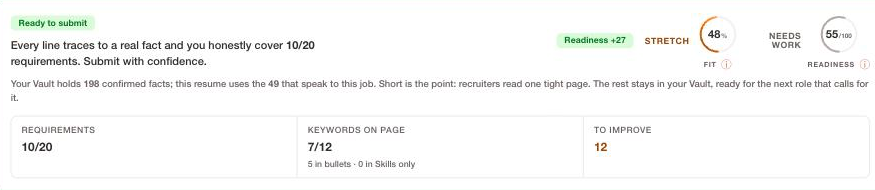
The third split is what happens to claims the machine cannot back up. In JobShifu, provenance is a build gate. Your exact numbers stay exact. If a bullet needs a number you never gave us, we ask you, we don't make one up. It won't claim a skill the job wants unless your own evidence backs it, and it tells you which requirements you genuinely match, partially match, and miss. That is a mechanism, not a promise: no source, no line.
The fourth split is what the tool does after you apply. JobShifu tracks every job with the exact resume and cover-letter version you sent, frozen, and drafts STAR interview stories from the same confirmed source as the resume bullets. Because every bullet traces to something you actually did, every bullet survives the interview. We'll even draft the 30-second story behind it, from the same source.