If a job asks for something your resume does not show, first check whether you have done it and simply never wrote it down. In JobShifu's data, 59% of users who tailored a resume confirmed at least one such fact while reading a posting. Recall one specific example, confirm your part, then write the bullet.
The one thing to leave out is anything you could not explain in an interview: a guessed percentage, a promotion from "helped" to "led", a tool you only watched someone else use.
How often a posting surfaces something the resume left out
JobShifu keeps each user's confirmed facts in the Vault, a reusable master resume, and records where every fact came from at the moment it is created. Most arrive from an uploaded resume. Some arrive later, when JobShifu compares the profile with one specific job, finds a requirement the resume does not show and asks the user whether they have done it. A fact counts only once the user confirms it.
On October 4, 2026, across 347 Vaults built since July 1 (administrator and test accounts excluded), the origins split like this. [1]
| Where the confirmed fact came from | Facts | Share |
|---|---|---|
| An uploaded document | 21,410 | 93.4% |
| Reading a specific job posting | 1,334 | 5.8% |
| Typed into the profile | 174 | 0.8% |
| All confirmed facts | 22,927 | 100% |
A small share overall, because every user uploads a document and only some go on to tailor. The tailoring group tells the story. Of the 125 users with at least one resume tailored to a specific job, 74 (59.2%) confirmed at least one fact while reading a posting, and 37 (29.6%) added an experience line rather than only a skill. In those users' Vaults, one confirmed fact in eight (12.5%) came from a posting rather than from the document they started with.
Two limits matter. The posting share is a floor: if a later upload restates a posting-added fact word for word, the merged fact takes the document's origin. And a confirmed fact is the user's statement, not an employer-verified record; the review step is what keeps it accurate. The aggregate data and definitions are published under CC BY 4.0.
Three reasons a requirement looks unmet
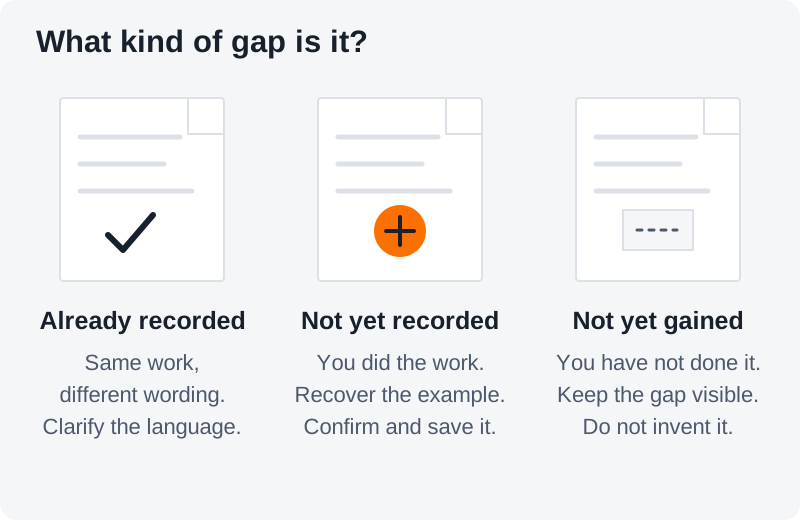
The work is there, in other words. Your resume describes the same thing in your former employer's vocabulary. Use clearer, equivalent language and keep the scope exactly as it was.
The work happened and never made it onto the page. This is the case the numbers above describe, and the only one worth an evening of recall. Recover the details, confirm them, then decide whether they belong in this application.
The work has not happened yet. Leave the gap visible. Related experience may still be worth describing, under its real label, or the role may simply be a poor fit.
The labels matter more than the vocabulary. Helping a colleague with a release is not owning the release process, and a course project is not production experience. Both can be worth a line when the line says what they were.
Questions that pull the example out
Pick one important responsibility from the posting and work through these before asking any tool to rewrite anything:
- When have I done something like this? Paid work, internships, coursework and volunteering all count. Keep the context explicit.
- What did I personally do? Separate your contribution from the team's result.
- What tools or methods did I use? Name only those you used in that example.
- What happened afterward? A measured result if you have one, otherwise a concrete outcome.
- What can I check? Permitted notes or records can refresh your memory. Confidential employer or customer information stays out of applications and AI tools.
Job titles hide this kind of work. A "support assistant" title can sit on top of training, documentation, scheduling or a process change nobody wrote down, so start from the work rather than the title.
A worked rewrite
Take a made-up developer whose resume says "Maintained backend services." The posting asks for someone to "investigate production incidents and document resolutions." Asked about it, the developer confirms three things: they were on an on-call rotation, they used service logs to investigate failed deployments, and they wrote recovery notes for teammates.
Proposed bullet: Investigated failed deployments during an on-call rotation and documented recovery steps for teammates.
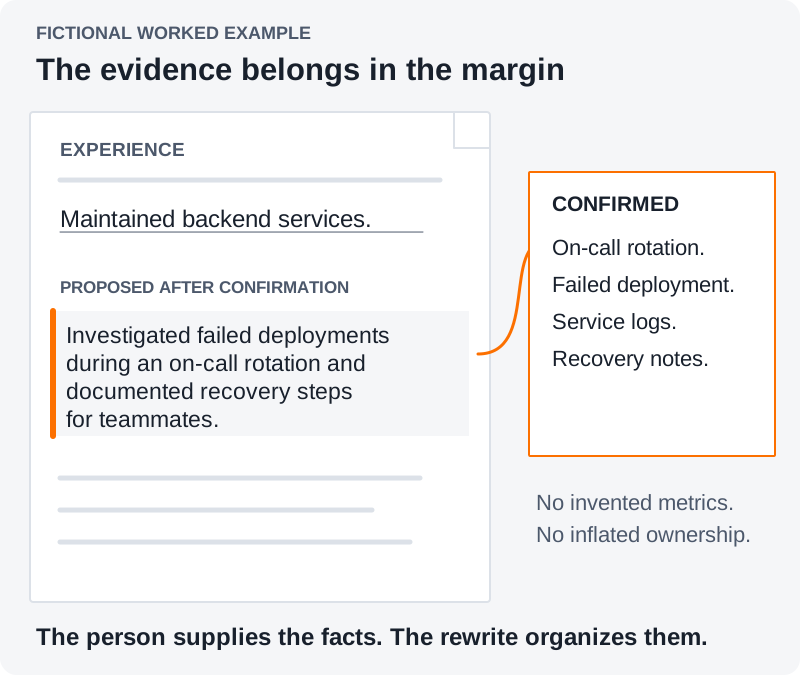
What the three facts do not support is just as useful to write down: "led incident response", "owned reliability", "reduced downtime by 40%". Each would need another fact. Read the new line back and ask whether you could walk an interviewer through the incident, your part and what happened next. Cut anything that gives you more responsibility than you had.
Keep the record, not just the bullet
Yale's career office recommends a master resume that is longer than any one application, selected down for each role. [2] The addition that makes it reusable is storing the facts behind each line next to the wording:
- Context: role, project and approximate date.
- Contribution: what you did yourself.
- Tools and outcome: what you used and what happened, without guessed measurements.
- Limits: what you assisted with, did not own or cannot substantiate.
- Used for: the applications where you included it.
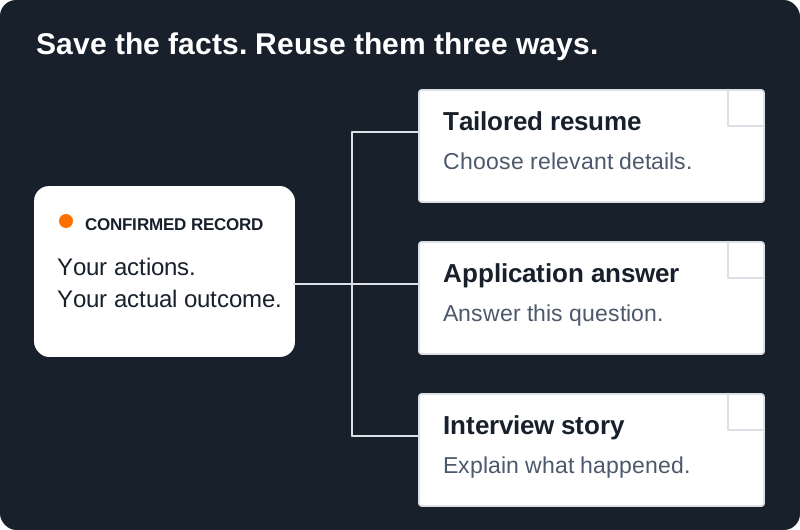
The on-call example above could become a reliability bullet, an answer to "tell us about a problem you solved" and an interview story. For most people who tailor, some posting surfaces another fact like it, so the record grows with each application instead of starting over.
Asking an AI tool to do the asking
An AI tool can compare a posting with your resume and spot an apparent gap. It cannot know an unrecorded project happened because the job needs it. Give it the requirement, a resume excerpt and this instruction:
Compare this requirement with my resume. If relevant experience is missing, ask me for a specific example before proposing a bullet. Separate what I confirm from what remains unknown. Do not add responsibilities, tools or results I have not provided.
JobShifu's resume tailoring is built on the same order of operations: it asks about the gap, saves what you confirm to the Vault, and leaves a qualification you do not have as a gap. [3] For the full editing pass afterwards, follow how to tailor a resume by hand.
Common questions
What if I cannot remember a number?
Describe the action and a result you can support. Add a measurement later only if you can verify it; an estimated percentage is the first thing an interviewer will ask about.
Can I include coursework or volunteer work?
Yes, when it is relevant and labeled. Name the context so a reader does not mistake a class assignment or volunteer project for paid professional experience.
Should everything I remember go into the resume?
No. The record can be long; each resume is a selection from it. Details that do not help this application stay available for the next one.
Is a skill I confirm the same as experience?
Not quite. Saying you know a tool is a skill claim; describing when and how you used it is experience. In the JobShifu data above, about two thirds of posting-added facts were skills and one third were experience lines, and the experience lines are the ones a resume bullet can stand on.
Sources
- JobShifu, Where confirmed resume facts come from: uploaded documents vs job postings, measured October 4, 2026 (UTC). Aggregates of JobShifu Vault records; 347 users, 22,927 confirmed facts.
- Yale School of the Environment, Office of Career and Professional Development, A note about resume writing from CPD, August 1, 2024; consulted September 14, 2026.
- JobShifu, Resume tailoring, product description consulted September 14, 2026. This guide is published by JobShifu.