There is a comfortable story about job applications: polish long enough and the resume wins on merit whenever it arrives. The arithmetic says otherwise. The average job posting drew 244 applications in 2025, up from roughly 115 in 2022, while over the same period the average recruiting team shrank from 10.43 recruiters to 4.62 [1]. More than twice the pile, read by less than half the people. A resume that arrives late is not judged against the job. It is judged against a queue that has already been sorted.
This post is published by JobShifu, and the numbers in it come from two places, both named: a published industry benchmark, and JobShifu's own crawl, with the query behind every figure written down.
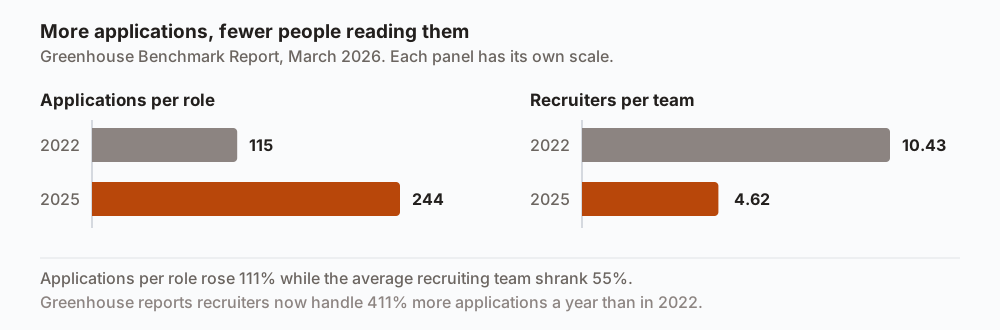
That is not a claim about your resume. It is a claim about queues. Somewhere in a pile of 244, a shortlist takes shape, and a late arrival has to beat someone the recruiter has already pictured in the seat.
A stale listing does not reject you. It quietly stops mattering, and you spent your best hour of the week on it.
Chris Cheng, Founder
Why nobody can tell you how long a posting stays open
It would be convenient to tell you exactly how long a posting keeps getting read. Nobody outside the company knows that, and JobShifu cannot see it either. What a crawler can see is when a posting appeared and when it stopped being listed, and those are different questions from when a recruiter stopped caring.
That distinction matters enough to state precisely, because it is the one most job-search content gets wrong. When a posting disappears from an employer's board, what has been observed is that it vanished. Whether the requisition was filled, frozen, or quietly left to expire is not visible from the outside. Any site that tells you a posting "dies" after a specific number of hours is describing its own crawl schedule, or nothing at all.
So this post does not carry a number for how fast a posting goes cold. JobShifu will publish one when its own crawl history is long enough to support it, and not before.
What a live crawl of 10,783 employer boards shows
Measured on 8 August 2026, JobShifu's corpus held 973,772 open postings, 848,395 of them distinct roles once duplicates of the same requisition are collapsed. Those came from 10,783 employer boards carrying at least one live opening. About 97.6% of open postings come straight from employer-run systems, Workday, Greenhouse, Oracle, SAP SuccessFactors, iCIMS, SmartRecruiters, Lever, Ashby and others, rather than from aggregator feeds [2].
Update, 22 August 2026: the remaining share is gone. The six remote-job aggregator feeds behind that 2.4% were retired, and every open posting in the corpus now comes from an employer-run system. The 97.6% above is left as measured on 8 August rather than rewritten, because it is what the crawl showed that day.
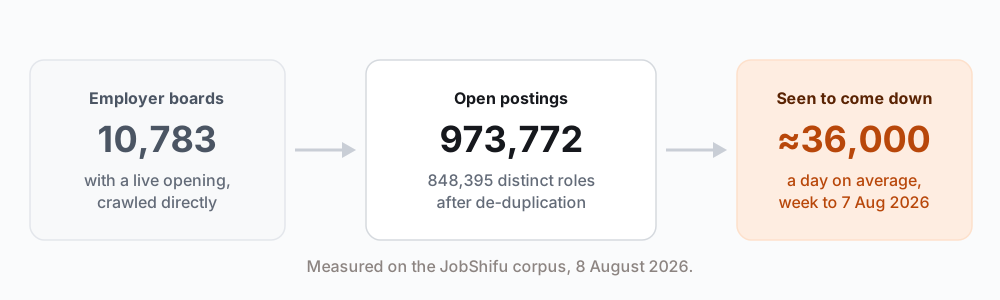
The churn is the part worth sitting with. Over the seven full days to 7 August 2026, JobShifu's sweep saw between 31,186 and 45,301 postings a day stop being listed, averaging 36,163 [2]. Arrivals over the same week were almost exactly in step: 249,966 postings first seen against 249,919 seen to come down. The board is not filling up. It is turning over.
One more number, published with its unflattering half. From the timestamp an employer's board gives a posting to that posting being searchable in JobShifu, the median is 2.5 minutes and the 90th percentile is about 18 hours, across 239,322 postings in a rolling seven-day window [3]. The median is the flattering figure. The tail is real, because quiet boards get crawled less often than boards that keep changing.
Does being early actually help?
Being early on its own does not rescue a weak application. Early and generic still loses to late and specific. Speed only pays when the application that arrives is the one this posting deserved: your real experience, arranged for this role, using the terms the job description actually uses.
Which makes this a workflow problem rather than a willpower problem. If tailoring a resume takes ninety minutes, freshness is unusable, and you will end up applying on Sunday to whatever is left. If it takes a few minutes, and you can see exactly what changed and why, applying while a posting is new becomes the default instead of a sprint.
If you are weighing tools on where their listings come from, the sourcing sits side by side in the JobShifu vs Jobright comparison.
How to use this when you sit down to apply
- Sort by posted date first, then filter for fit. In a queue of 244, position is not nothing, and it is the only input that is already gone by the time you notice it.
- Tailor from what you already have, never from a blank page. The blank page is what makes the window unusable in practice.
- Let fresh postings come to you. A daily digest of new, well-matched roles beats refreshing job boards by hand, and it beats doing it inconsistently by a wider margin still.
What you can still fix after the queue has moved on
Timing is the input you cannot recover afterwards. Everything else you still can: the resume can be sharper, the wording can sit closer to the posting, the summary can lead with the thing this particular employer cares about.
JobShifu ranks fresh postings against experience you have confirmed, and every line of a tailored resume cites the confirmed experience it came from. If you did not do it, it does not go on the page. No source, no line.
Common questions
How many people apply for the same job?
The average job posting drew 244 applications in 2025, up from roughly 115 in 2022, while over the same period the average recruiting team shrank from 10.43 recruiters to 4.62 [1]. More than twice the pile, read by less than half the people. That ratio is why a position in the queue is worth anything at all.
What does it mean when a job posting disappears?
Only that it stopped being listed. Whether the requisition was filled, frozen, or quietly left to expire is not visible from outside the company, and no crawler can see it. Over the seven days to 7 August 2026 JobShifu's sweep saw an average of 36,163 postings a day come down, against almost exactly as many arriving [2]. The board is not filling up, it is turning over.
Should I still apply to a posting that is a few weeks old?
If it is a genuine fit, yes, but treat timing as the one input you cannot recover afterwards. Everything else you still can: the resume can be sharper, the wording can sit closer to the posting, and the summary can lead with what this particular employer cares about. Early and generic still loses to late and specific.
Sources
- Greenhouse, "The Hire Standard" Benchmark Report, March 2026. Covers 6,000+ companies and 640M+ applications, with data spanning 2022 to 2025. The 244 figure is the 2025 value, not a 2026 one. Greenhouse hiring benchmarks. Read 8 August 2026.
- JobShifu corpus, measured 8 August 2026. Open postings, distinct roles, employer board count, source mix and the daily close-stale counts are all single queries against the crawl database; the queries are recorded in the working notes that accompany this post.
- JobShifu ingest latency, read from the public `public-stats` endpoint on 8 August 2026: median 2.5 minutes, 90th percentile 1,088.7 minutes, sample 239,322 postings over a rolling seven-day window.