Keep an answer bank of the facts behind your answers, not finished paragraphs. Across 152,857 application forms JobShifu captured, the most re-asked question, visa sponsorship, appeared at 62% of employers in 5,527 different wordings. Store each fact and experience once, adapt the wording to each form, and re-check every yes/no answer.
JobShifu application answer bank template. A free spreadsheet with one row per saved answer or experience: its group (reusable fact, adaptable evidence or fresh decision), the evidence behind it, what it does not support, when you last checked it and the version you submitted. Download the CSV and open it in Excel, Numbers or Google Sheets.
The ten questions employers re-ask most
JobShifu captures the public application form of every open posting it can reach on Greenhouse, Ashby, Lever and Rippling. On October 4, 2026 that was 152,857 open postings from 7,388 employers. Grouping each employer-written question by what it asks, rather than by its exact text, gives this ranking. [1]
| # | Question family | Employers asking | Distinct wordings | Where it belongs in the bank |
|---|---|---|---|---|
| 1 | Will you need visa sponsorship? | 61.9% | 5,527 | Reusable fact, checked per country |
| 2 | Are you authorized to work here? | 54.5% | 3,814 | Reusable fact, checked per country |
| 3 | Salary expectation | 41.4% | 4,199 | Fresh decision |
| 4 | On-site, hybrid or commute | 33.9% | 6,833 | Fresh decision |
| 5 | How you heard, or who referred you | 33.5% | 1,856 | Fresh decision |
| 6 | Years of experience in something | 30.4% | 8,591 | Reusable fact, per skill |
| 7 | Where you live now | 29.6% | 3,850 | Reusable fact |
| 8 | Tell us about a time | 22.3% | 5,291 | Adaptable evidence |
| 9 | Notice period or start date | 19.5% | 1,207 | Reusable fact, kept current |
| 10 | Willing to relocate | 19.4% | 2,896 | Fresh decision |
Shares are of the 7,388 employers with at least one open captured form. The published data adds per-posting shares, the most common wording in each family and the next ten families.
The wording column is the case for an answer bank built on facts. Work authorization is the most standardized family, and its most common phrasing is still used by only 22% of the employers who ask it. For visa sponsorship the figure is 4%, and for "tell us about a time" it is under 1%: almost every employer writes its own. A bank of pasted paragraphs keyed on exact question text would miss nearly all of them. A bank of facts does not care how the question is phrased.
Two caveats. The families come from pattern matching on question labels, checked by reading samples, so a small share of questions sit in the wrong family. And labels that name the employer count as separate wordings, which makes the wording counts an upper bound.
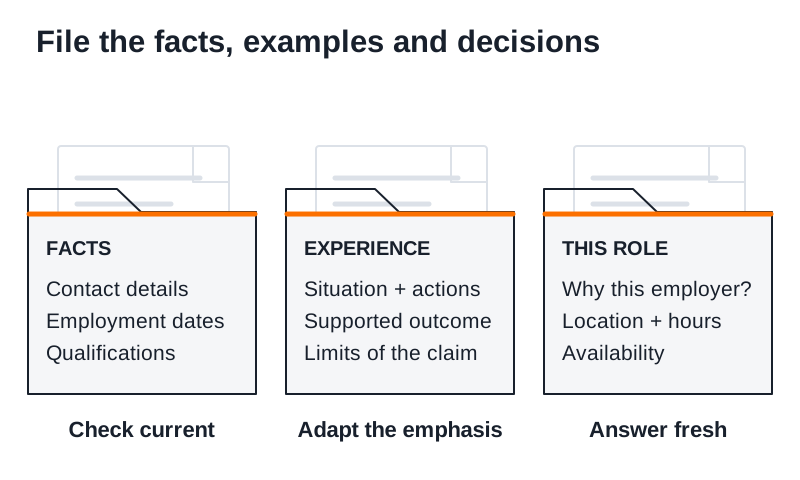
Similar wording is also where a saved yes/no answer goes wrong. "Can you travel?" and "Can you travel internationally during the first month?" ask different things, and "Will you now or in the future require sponsorship?" is a different question from "Do you need sponsorship to start?" Save the underlying fact (your citizenship, your visa and its end date), then answer each question as written.
Save an evidence card before writing the paragraph
Row 8 of the table is where most rewriting time goes, because every employer phrases it differently. An evidence card records what happened, once, so each new phrasing is an edit rather than a blank page:
- Situation: the task or problem, with enough context to understand it.
- Your responsibility: what you owned, and where someone else was responsible.
- Actions: the concrete things you did.
- Result: what changed and how you know. A documented outcome does not have to be a percentage.
- Boundaries: claims the example does not support.
- Useful questions: the themes this example could help answer.
Keep sensitive company information out of a general application bank. Describe the work at an appropriate level and use only material you are allowed to share.
The boundaries field earns its place when an AI tool drafts from the card. It tells you what to reject if a rewrite turns participation into leadership or adds a result you never measured.
One card, two answers
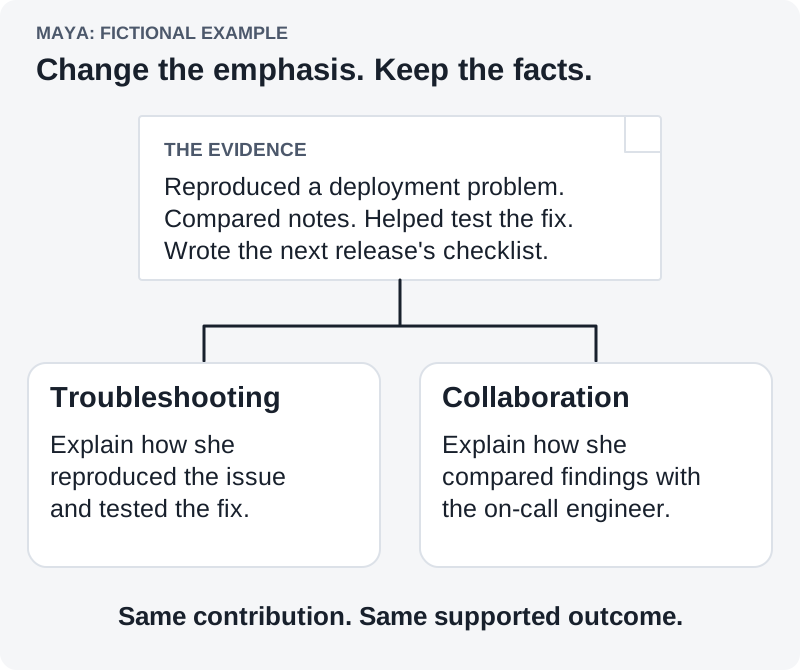
Maya is invented for this example. Her card: she was an engineer on a release that failed during deployment. She reproduced the configuration problem, compared notes with the on-call engineer, and helped test the correction. Afterward, she wrote a pre-release checklist that the team used on its next release. She did not lead the incident response and did not measure a reduction in failures.
For "Tell us about a technical problem you solved," Maya could write:
"During a failed deployment, I reproduced a configuration problem and worked with the on-call engineer to test the correction. I then documented the checks in a pre-release checklist, which the team used on its next release."
For "Tell us about working with another team member," she could write:
"During a deployment failure, I compared my reproduction steps with the on-call engineer's findings so that the correction addressed the same problem. I helped test the fix and wrote a checklist the team could use before the next release."
The emphasis changes. The responsibility and outcome do not, and neither answer needs an invented failure-rate improvement or a promotion to incident commander.
Keep the submitted version with the application
The bank is source material. The application record is what you actually sent, and later edits to a reusable answer should not erase the version an interviewer may have read. Record the employer, role, submission date, resume filename and final answers. If the form offers a review page or download, save it; otherwise keep your own copy before submitting.
Candidate profiles on the ATS side help with part of this. Greenhouse's QuickApply guidance describes reusing profile information and editing autofilled fields before submission, and its candidate FAQ says the latest resume is the default and the profile does not store multiple resume versions. So check the attachment even when the profile details look right. [2]
Review rather than rewrite
Before pasting a saved answer, ask:
- Does it answer this exact question, including its time frame and country?
- Are the facts still current?
- Does it distinguish my contribution from the team's?
- Is there a role-specific condition or length limit?
- Can I explain every sentence in an interview?
An answer that clears all five may not need rewriting at all. JobShifu's autofill is built on the same split: it reuses saved answers on supported forms, keeps confirmed experience in the Vault, a reusable master resume, and leaves the review and the submit button to you.
Common questions
Can I use the same example for several employers?
Yes, if it is accurate and answers each question. Change the emphasis and the employer-specific context rather than inventing another experience.
What if the form asks a yes/no question?
Read every condition before reusing a response. Some employers configure screening rules around application answers, so a saved answer deserves the same factual review as a new one.
Should I save a salary number in the bank?
Save the inputs instead: your current range, what you need, and notes from the posted ranges of similar roles. Salary expectation is the third most common question in the table above, and the right figure depends on the role, location and posted range in front of you.
Sources
- JobShifu, The application questions employers re-ask most, and how many ways they word them, measured October 4, 2026 (UTC). 152,857 open postings' application forms, 7,388 employers, captured September 24 to October 4, 2026.
- Greenhouse, MyGreenhouse FAQ for Candidates, accessed September 15, 2026 (UTC).